
3rd part of Who is Soraida Salwala?
by Sean Whyte
The days passed and soon turned into weeks. Reports from Thailand told of a great increased effort to help Honey. She was now being cared for day and night by zoo vets and officials. (Learned later that all wages and expenses were paid by FAE and Soraida herself.
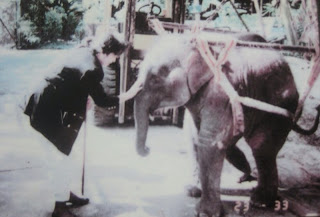
A harness had even been made and secured to raise her off the ground without inflicting further strain on her fractured pelvis. This enabled the vets to treat her worsening bedsores.
Then one day came the dreaded message from a distressed Soraida, “HONEY has died.” After three months Honey could hold out no longer, her weakened body simply unable to cope with the massive injury she had sustained.
That was 1993, a life changing for Soraida. If she was strong and determined before HONEY’s death, she was UNSTOPPABLE now. Leaving her family jewellery business, with the help of Dr. Preecha Phuangkum, a vet with government sector Soraida established the FRIENDS OF THE ASIAN ELEPHANT foundation just a few months before Honey’s accident.
Her love of elephants had begun more than thirty years earlier. Traveling with her family, as a child of eight years in the northeast of the country, they happened upon an elephant lying beside the road. They discovered that a lorry had struck this enormous pachyderm. Getting back into the car, her father explained that nothing could be done to help this poor animal. “We should take him to the doctor Papa”, Soraida cried out. “How can we take him, my dear, he is very big?” As they drove by a gunshot was heard and her father explained, “Uncle elephant is in heaven now, my dear.”
A century ago up to 100,000 elephants worked in the logging and transport business. Poaching, deforestation and loss of habitat have reduced the domesticated population to less than 4,000, while the wild population has dropped to below 2,000.
The pace at which the forests are being cut down, mostly illegally, is such that their greedy owners treat many of the elephants very harshly. One particularly serious problem is that elephants are habitually fed bananas laced with drugs, to give them greater strength to haul giant logs way beyond the capability of any normal elephant.
 Five years after first meeting Soraida I found myself standing in a fully-fledged elephant hospital on a hillside some 20 miles north of Lampang, Northern Thailand. I had known for a longtime that Soraida had fulfilled her dream of building the world’s first Elephant Hospital, but nothing quite prepared
me for its impressive scale.
On the way from the airport to the hospital, Dr. Preecha Phuangkum, the hospital’s Chief Vet, began to explain the scale of the challenge facing them. To illustrate a point he stopped the car on a roadside. As far as the eye could see there was only green undergrowth and spindly looking trees “This was once virgin forest. I can remember well the great trees that once grew here. Everything you now see is secondary-growth bushes and trees,” said Dr. Preecha.
“Step out of the car for a moment. Listen, can you hear a single bird singing?” Dr. Preecha invited me. I could not, the silence being broken only by large trucks rolling by, heading south in a cloud of dust, laden with logs and bamboo.
“Local people just don’t understand. No trees mean no wild fruits, which in turn results in no insects or birds-there is nothing for anything or anyone to survive on. All the wild animals have been hunted out, and besides there is nothing for them to eat. This place is now virtually dead, useless to everyone. This is what illegal logging does to our country.” Dr. Preecha went on. The story is much the same elsewhere in Asian with wildlife being crammed into ever smaller and fewer wild spaces.
Soraida met us at the hospital and, as I gazed around, I could barely believe my eyes. There, around me, were elephants being attended by their mahouts (men who care for and control the elephants). Solid looking, open sided structures provided shade for the recuperating elephants. We went to look at the veterinary clinic building, one I’m sure any western vet would be proud to work in. What was a dream five years earlier was now a fully functional hospital for elephants, a world first.On the way from the airport to the hospital, Dr. Preecha Phuangkum, the hospital’s Chief Vet, began to explain the scale of the challenge facing them. To illustrate a point he stopped the car on a roadside. As far as the eye could see there was only green undergrowth and spindly looking trees “This was once virgin forest. I can remember well the great trees that once grew here. Everything you now see is secondary-growth bushes and trees,” said Dr. Preecha.
“Step out of the car for a moment. Listen, can you hear a single bird singing?” Dr. Preecha invited me. I could not, the silence being broken only by large trucks rolling by, heading south in a cloud of dust, laden with logs and bamboo.
“Local people just don’t understand. No trees mean no wild fruits, which in turn results in no insects or birds-there is nothing for anything or anyone to survive on. All the wild animals have been hunted out, and besides there is nothing for them to eat. This place is now virtually dead, useless to everyone. This is what illegal logging does to our country.” Dr. Preecha went on. The story is much the same elsewhere in Asian with wildlife being crammed into ever smaller and fewer wild spaces.
“We have so far treated over 400 cases (over 3,000 cases now from 1993-2011) free of charge-poor animals which otherwise would have gone on in pain, many to an early death,”
“This makes me happy but there is so much more we need to do, the situation is desperate. Take Kamme there, a female elephant in her early fifties, she came to us with terrible injuries caused by the cruel treatment meted out by loggers; on top of this she had been regularly fed amphetamines to make her work longer hours, and now she is addicted to them.” Soraida told me.
You've added this content to your favorites.

Post your comment
Load More


